Each year the University of Chicago allows selected undergraduate research to be presented at the Undergraduate Research Symposium. UCSP has presented 8 different posters at the research symposium over the past two years with plans to present another 4 this upcoming April. Learn about each of our posters below.
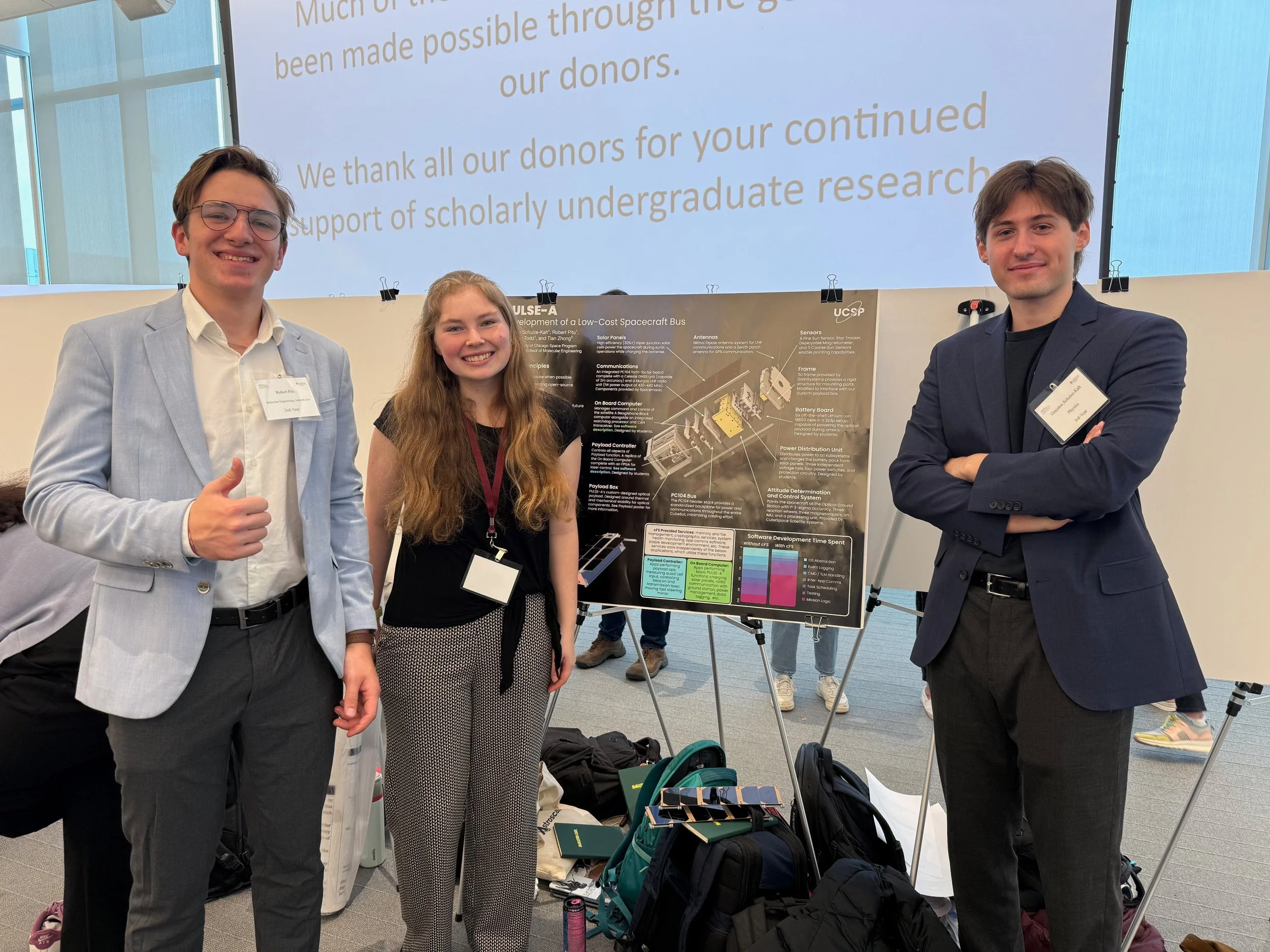
Graydon Schulze-Kalt, Robert Pitu, and Catherine Todd presented a poster entitled Development of a Low-Cost Spacecraft Bus for the PULSE-A CubeSat. See the abstract below.
Recent advances in space-based sensing technologies have allowed for small satellite missions to collect increasing volumes of data, dramatically increasing the demand for high-bandwidth downlink. Although space-to-ground communication is typically accomplished using radio frequency (RF) transmission, RF transceivers capable of supporting high data rates present significant size, weight, power, and cost (SWaP+C) restrictions. Optical communication presents a promising alternative, enabling order-of-magnitude increases in data rate over RF with less stringent SWaP+C requirements and improved downlink security. The Polarization-modUlated Laser Satellite Experiment (PULSE-A) is a University of Chicago mission to accomplish space-to-ground optical transmission at up to 10 Mbps using circular polarization shift keying (CPolSK). PULSE-A aims to study the advantages of using CPolSK for optical downlink and make optical communication technology more accessible through the mission’s commitment to open-source design. The mission includes a 3U CubeSat containing a <1.5U optical transmission terminal payload, a lightweight optical ground station functioning as a CPolSK receiver, and an RF ground station. In addition to the mission’s technical objectives, PULSE-A serves an essential educational role: nearly all of the mission’s hardware and software are being developed by a team of over 60 undergraduate students from the University of Chicago Space Program. In this presentation, we will provide an overview of the PULSE-A mission, detailing the current design for the CubeSat and ground station. We will also discuss the impacts and lessons learned from the PULSE-A Team’s student-led engineering and project management. We will conclude with a discussion of PULSE-A’s upcoming design work and expected growth areas.
Download our poster here
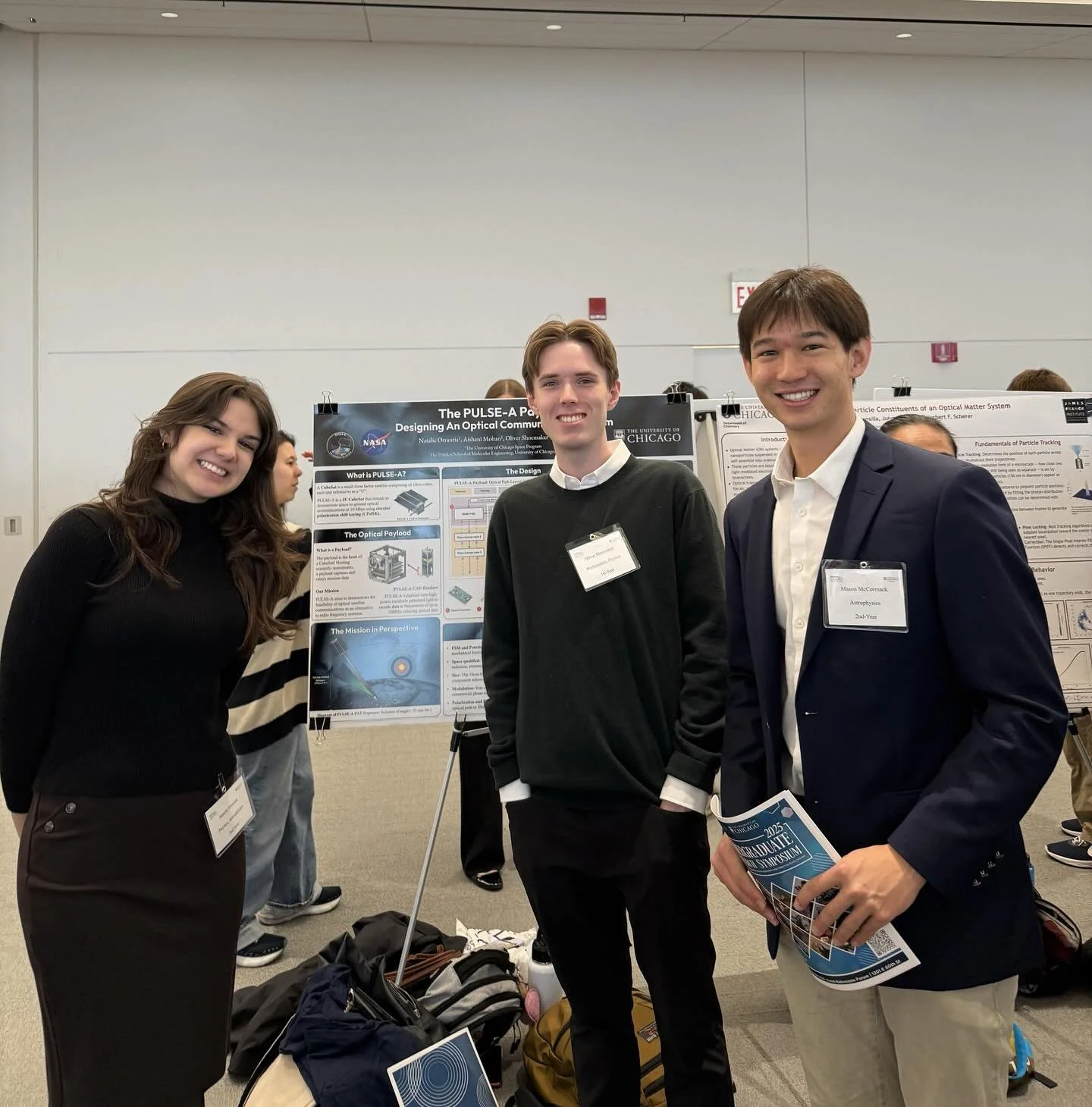
Natalie Orrantia, Aishani Mohan, and Oliver Shoemaker presented a poster entitled The PULSE-A Payload: Designing An Optical Communication System. See the abstract below.
The Polarization-modulated Laser Satellite Experiment (PULSE-A) at the University of Chicago aims to demonstrate circular polarization shift-keyed (CPolSK) satellite-to-ground-links. This presentation focuses on the satellite payload, which encodes and transmits data encoded via circular polarization states, to be detected and decoded at the ground station. The payload system is a compact, low-loss optical communications terminal with two key assemblies: one for body-pointing to the ground station, and another for data transmission and preparation. The system starts with two orthogonally polarized seed lasers at 1550 nm, encoding data via a high-speed polarization switch.The signal is amplified and passed through a quarter-wave plate to produce circular polarization. On the reception side, a collection system gathers beacon light, filters out irrelevant wavelengths, and focuses the light onto a detector to adjust the beacon for accurate ground-satellite pointing. Zemax OpticStudio simulations are underway to validate the design’s feasibility. Some of the challenges with the design include preserving polarization states at the optical assembly and in the atmosphere. Components were chosen based on their performances in space and how well they can maintain the polarization until data is transmitted. Experiments are currently underway to analyze the evolution of the polarization state across the system, setting limits on the allowable ellipticity and uncertainty in the final polarization state to be detected. These limits are crucial for ensuring the integrity of the transmitted data and optimizing error correction strategies in the receiver. Ultimately, PULSE-A aims to advance high-speed laser communications as a competitive alternative to traditional radio frequencies (RF), offering data rates comparable to high-end RF systems while reducing size, weight, and power.
Download our poster here
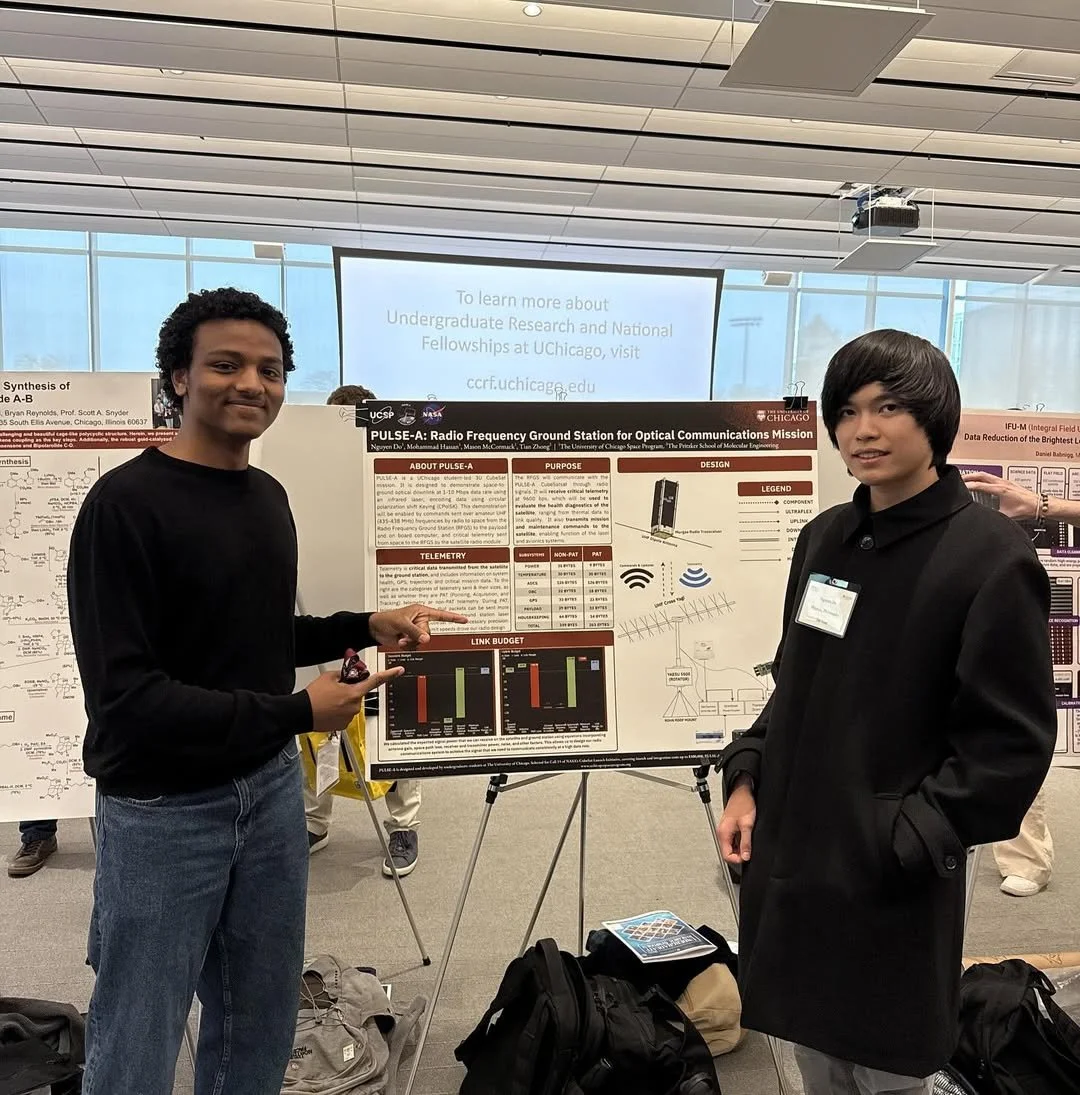
Nguyen Do, Mohammad Hassan, and Mason McCormack presented a poster entitled PULSE-A Radio Frequency Ground Station for Optical Communications Mission. See the abstract below.
The Polarization-modUlated Laser Satellite Experiment (PULSE-A) is the University of Chicago’s student-led mission to demonstrate a space-to-ground optical downlink at a data rate of 1 to 10 Mbps using circular polarization shift keying. PULSE-A comprises a 3U CubeSat bus carrying a <1.5U optical transmission payload and a ground station consisting of the optical ground station (OGS) and the radio-frequency ground station (RFGS). The purpose of the RFGS is to communicate with the satellite by receiving critical telemetry used to evaluate the health diagnostics of the satellite, ranging from thermal data to link quality. Transmissions from Low Earth Orbit support PULSE-A’s optical communication mission using half-duplex communication on the 430-435 MHz amateur UHF band. During the pointing, acquisition, and tracking (PAT) sequence, the RFGS will continuously update the CubeSat’s positional data, allowing the OGS to refine telescope pointing for accurate satellite tracking, ensuring robust beacon acquisition between the satellite and ground station. To achieve this, the RFGS will utilize a cross-yagi antenna, UHF transceiver, software-defined radio (SDR), low-noise amplifier (LNA), and bandpass filter for reliable signal transmission. To validate our system’s capability, we have begun receiver testing with geosynchronous and CubeSat satellites. We will file for experimental licensing for the RFGS and satellite radio module with the FCC and ITU following the final selection of the satellite radio module. In this presentation, we will be discussing our design and verification of the RFGS system, highlighting the process of selecting both hardware and software components and their implementation.
Download our poster here
Leah Vashevko, Juan Prieto Asbun, and Ashley Ashiku presented a poster entitled PULSE-A: Polarization-Based Optical Communications Ground Station. See the abstract below.
The Polarization-modUlated Laser Satellite Experiment (PULSE-A) is the University of Chicago’s student-led mission to demonstrate a space-to-ground optical downlink at a data rate of 1 to 10 Mbps using circular polarization shift keying (CPolSK). PULSE-A comprises a 3U CubeSat bus carrying a <1.5U optical transmission payload and a dual optical-RF ground station. The ground station system consists of the optical ground station (OGS) and the RF ground station (RFGS). The RFGS is responsible for routine communications and control tasks, while the experimental OGS receives the optical transmission from the satellite’s payload. The OGS tracks, collects, and decodes the transmitted signal using four assemblies: tracking, polarization state preparation, signal decoding, and beacon. Since optical communications are directional, the tracking assembly must precisely point a telescope at the satellite with an accuracy of 1.4 mrad. After coarse pointing of the telescope, the satellite sends down a beacon laser. The OGS then tracks deviations of the laser to correct the telescope’s position for fine pointing. The polarization state preparation assembly separates light by its left- or right-handed circularly polarized state by passing it through a quarter-wave plate, converting it into linearly polarized light. This light is then split by a polarizing beam splitter into two paths, corresponding to the initial left- or right- handed state. Next, the signal-decoding assembly converts the separated light into two voltage channels corresponding to 1 or 0 bits, which are then digitized by an FPGA. Lastly, the OGS beacon assembly includes a laser that enables the satellite to track the ground station. In this work, we present an overview of the design of the ground station, focusing on implementing a polarization-based optical communications receiver. We explore the design of polarization-based optics for space-to-ground communications with emphasis on the challenges associated with the directionality of optical communications.
Download our poster here
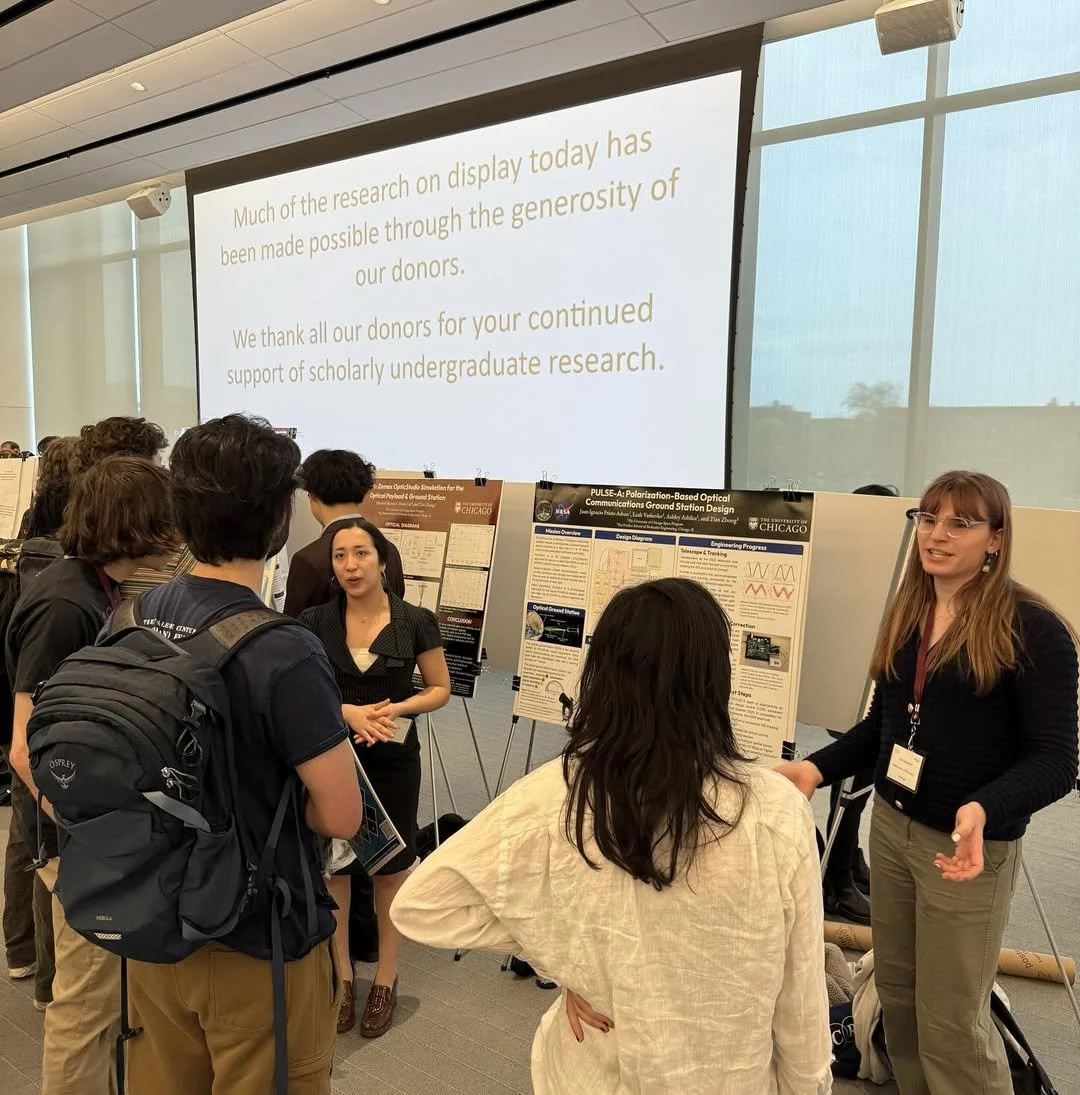
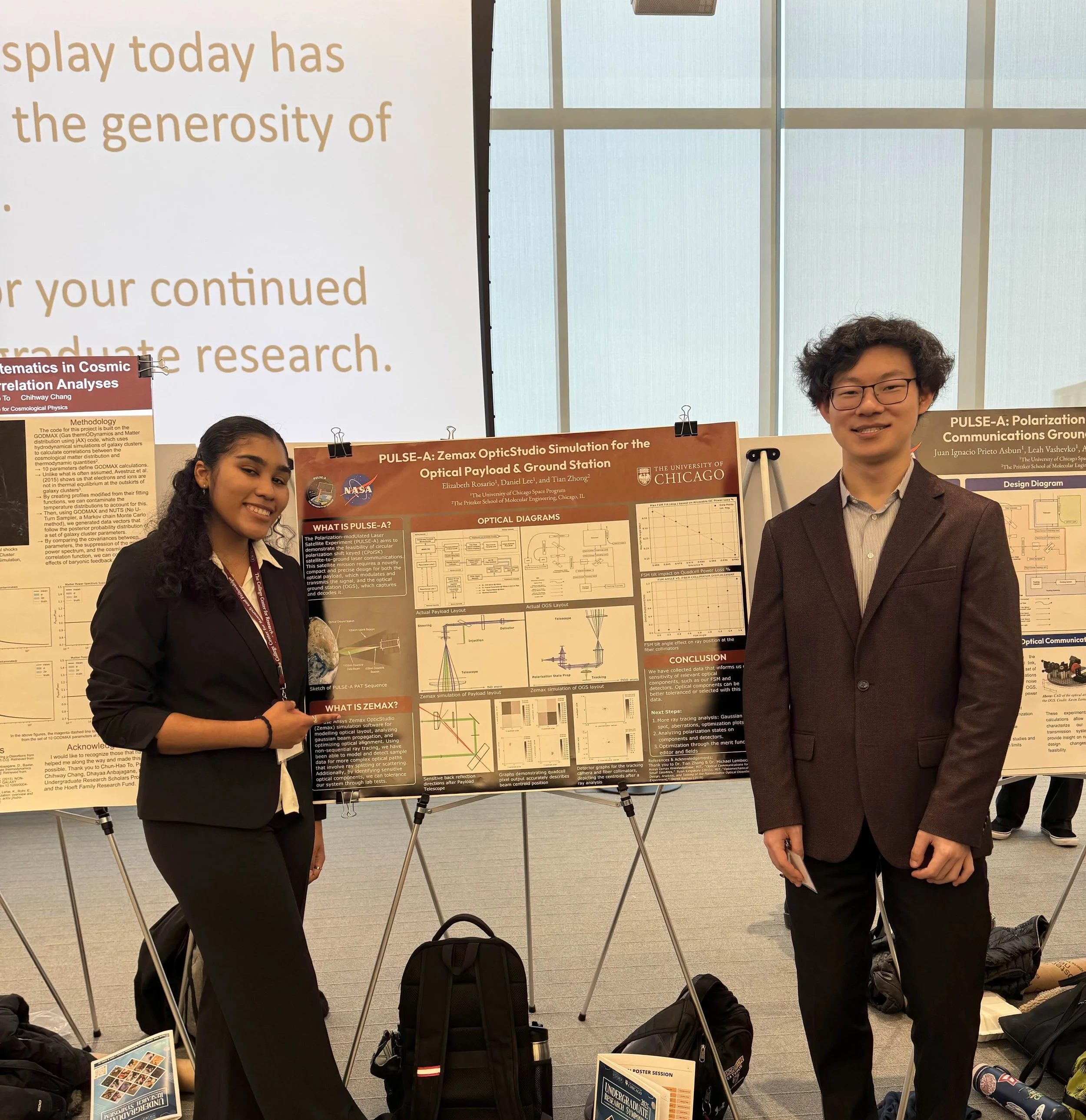
Elizabeth Rosario and Daniel Lee presented a poster entitled PULSE-A: Zemax OpticStudio Simulation for the Optical Payload & Ground Station. See the abstract below.
The Polarization-modUlated Laser Satellite Experiment (PULSE-A) at the University of Chicago aims to demonstrate the feasibility of circular polarization shift keyed (CPolSK) satellite-to-ground laser communications. This satellite experiment requires a novelly compact and precise design for both the optical payload, which modulates and transmits the signal; and the optical ground station (OGS), which captures and decodes it. Ansys Zemax OpticStudio (Zemax) software’s customizability allows for precisely and efficiently simulating theoretical calculations that would be more difficult to model otherwise. We use Zemax for modelling optical setups—to determine what experiments to conduct in the lab and simulate general layout—and for analyzing ray traces, which will allow us to perform optimizations on component alignment or thermal regulation in the future. Beyond standard lenses or surfaces, we have used the Zemax programming language to more accurately model more complex optical components such as the surface reflectance coatings on dichroics, bandpass filters, and fast-steering mirrors. Additionally, with Zemax’s flexible non-sequential ray tracing, we have been able to model and detect sample data for more complex optical paths that involve ray splitting or scattering. For detector simulation, we have used irradiance maps to model detector output data on beam position detection resolution, power losses through the optical setup, and extraneous scattering light. We plan to improve ray polarization modelling, utilize multiple configurations and sequential-tracing plots for tolerancing components, and implement the merit function for design optimization. In this poster, we present our use of Zemax OpticStudio’s ray tracing capabilities and detail some optimization resources that we believe will further improve our optical payload and OGS designs of the PULSE-A Mission.
Download our poster here
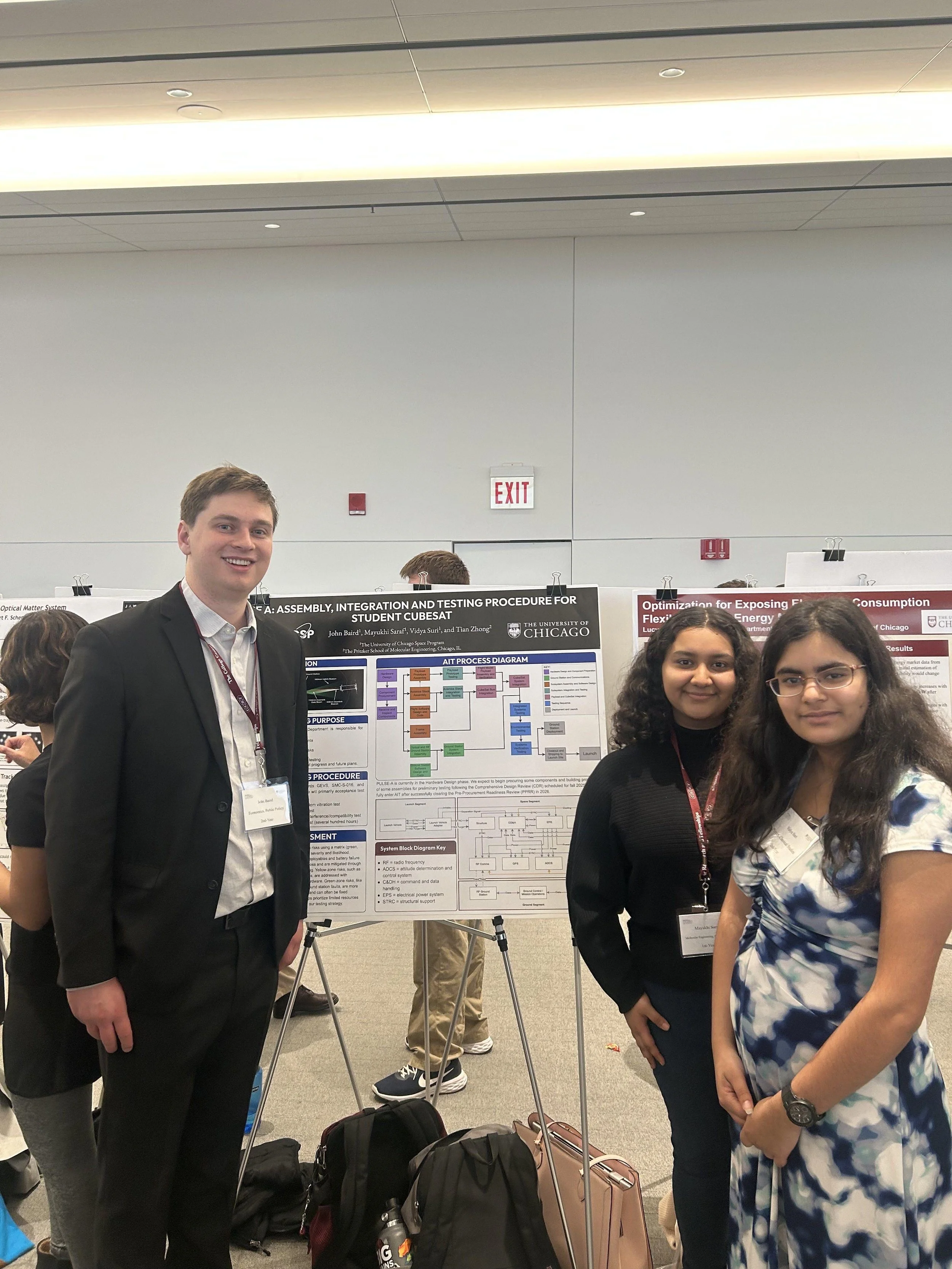
John Baird, Mayukhi Saraf, and Vidya Suri presented a poster entitled PULSE-A: Assembly, Integration and Testing Procedure for Student CubeSat. See the abstract below.
The Polarization-modUlated Laser Satellite Experiment (PULSE-A) is the University of Chicago Space Program’s student-led mission to demonstrate an optical downlink at a data rate of 1-10 Mbps using circular polarization shift keying. PULSE-A comprises a 3U CubeSat bus carrying a <1.5U optical transmission terminal and a dual optical-RF ground station. The PULSE-A team has developed systems engineering, assembly, integration and testing plans to ensure a well-integrated mission design through analyzing subsystem interfaces, managing design constraints, and verifying and validating system requirements. To ensure that the final product will achieve mission goals, we have developed mission, functional, and performance requirements detailed in the System Requirements Document (SRD). The SRD guides system design, serves as a reference for verification processes, and drives risk management and decision-making throughout the mission lifecycle. We are also currently developing integration plans for the satellite’s interfaces, which will guide verification through functional and performance tests in the assembly process. This includes planning contingencies for subassembly replacements in case of failures during testing to minimize schedule delays. Additionally, the PULSE-A team has planned environmental tests for the integrated system to ensure mission success and verify all externally and internally imposed requirements. These include thermal vacuum cycling, thermal balance, and electromagnetic interference testing (self-imposed), as well as random and sinusoidal vibration testing (required) at protoqualification and acceptance levels. Finally, PULSE-A’s system engineering program includes robust mission assurance strategies, addressing risks across technical, schedule, programmatic, and cost domains to minimize potential mission failures. The next steps for PULSE-A systems engineering include developing and implementing a Systems Engineering Management Plan (SEMP) to define standard operating procedures throughout the mission lifecycle, as well as finalizing assembly, integration and testing plans prior to the upcoming Critical Design Review (CDR).
Download our poster here